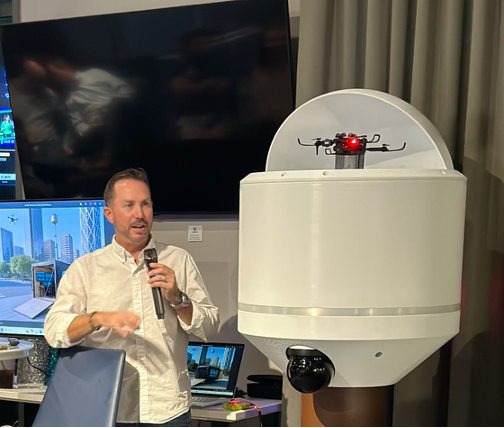
GALE Project Technologies Successfully Tests “Pinger” Micro Drone Detector with Law Enforcement and Federal Observers
Gale Project Technologies, Inc. has successfully completed live field testing of its ultra-compact drone detection device, Pinger, in collaboration with the San Antonio Police Department (SAPD), with participation from federal-level observers.
This milestone represents a major step forward in validating low-cost, scalable drone detection technology for public safety, infrastructure protection, and defense applications.
What is Pinger?
Pinger is a compact, cost-effective Remote ID drone detection device designed to identify, track, and log unmanned aerial systems (UAS) in real time.
See something off about this company?
Unlike traditional counter-UAS systems that rely on expensive radar, RF triangulation, or complex multi-sensor architectures, Pinger leverages the emerging Remote ID ecosystem to deliver:
All at a fraction of the cost of legacy drone detection systems. $249
Live Testing with SAPD and Federal Observers During controlled field operations with SAPD:
Federal observers were present during testing, providing insight into real-world deployment potential across public safety and government use cases.
Key Results Testing demonstrated that Pinger can:
Most importantly, the testing confirmed that effective drone detection does not require high-cost infrastructure.
Toward the Most Affordable Drone Detector on the Market
GALE’s objective with Pinger is to make drone detection accessible at scale.
By focusing on compact hardware, Remote ID-based detection, and simplified deployment, Pinger is positioned to become one of the most affordable drone detection solutions available.
This enables deployment across a wide range of users, including:
In addition to detection, Pinger enables scalable drone activity data collection.
Each deployed unit contributes to:
At scale, this creates a distributed network of drone activity data, supporting applications in:
Pinger is designed to operate as both a standalone solution and as part of the broader GALE system.
The GALE platform integrates:
This allows Pinger to serve as a foundational layer for scalable drone detection and airspace awareness within a larger intelligent infrastructure network.
What’s Next Following successful validation, GALE is advancing:
The company is actively engaging with government, law enforcement, infrastructure stakeholders, and investors aligned with dual-use technology.
Summary This field test marks a critical milestone in the evolution of drone detection technology.
Pinger demonstrates that drone detection can be:
GALE is positioning Pinger as a key solution in the transition from specialized counter-UAS systems to widely deployed airspace awareness infrastructure.
Milestone Announcement: GALE System Patent Granted\r\n\r\nGale Project Technologies has reached a major milestone with the U.S. Patent Office issuing a Notice of Allowance for the company’s core platform patent, titled “Remote Modular Data Collection and UAS Docking System and Method.”\r\n\r\nThe patented GALE System transforms existing infrastructure—such as utility poles, buildings, and critical facilities—into autonomous monitoring and rapid-response platforms capable of collecting real-time data and deploying drones directly from the structure itself. By integrating edge AI, multi-sensor fusion, and autonomous drone docking technology, GALE enables persistent monitoring and on-demand aerial response within seconds of an incident.\r\n\r\nThis innovation addresses several major global challenges.\r\n\r\nAcross cities, campuses, utilities, and critical infrastructure, situational awareness and rapid response remain limited by human dispatch times and fragmented monitoring systems. Traditional security cameras provide only passive observation, while drone response often requires a pilot to travel to the site and launch manually—losing valuable time during emergencies.\r\n\r\nThe GALE System solves this by creating always-ready autonomous response nodes that can detect events, analyze conditions locally using edge AI, and deploy drones instantly to gather live aerial intelligence. This capability dramatically improves response times for incidents such as:\r\n\r\n• Public safety emergencies\r\n• Disaster response and search operations\r\n• Critical infrastructure monitoring\r\n• School and campus security\r\n• Utility and grid inspection\r\n• Environmental, agriculture and disaster monitoring\r\n\r\nBecause GALE can be installed on existing infrastructure, the system is designed to scale rapidly and cost-effectively across cities, campuses, and large property networks.\r\n\r\nThe market opportunity for this technology is significant. The global markets for public safety technology, drone infrastructure, smart city systems, and critical infrastructure monitoring collectively represent a total addressable market exceeding $100B+ over the next decade. With increasing demand for autonomous monitoring, drone-as-first-responder programs, and AI-enabled situational awareness, GALE is positioned at the intersection of several rapidly expanding sectors.\r\n\r\nThe patent strengthens Gale Project Technologies’ defensible intellectual property position around autonomous drone docking, infrastructure-based deployment, and integrated sensor monitoring platforms.\r\n\r\nFollowing this milestone, Gale Project Technologies is opening its Seed funding round to accelerate product deployment, strategic partnerships, and manufacturing readiness as the company moves toward bringing the GALE platform to municipalities, security organizations, and critical infrastructure operators.
GALE Project Achieves Revenue Milestone with First HaloDome™ Sale\r\n\r\nNew Braunfels, Texas — 2026\r\n\r\nGale Project has reached a major company milestone: transitioning from development-stage innovation to revenue-generating operations following the production and first commercial sale of its HaloDome™ drone Remote ID detection system.\r\n\r\nOriginally designed to go into the Gale System node, it is also a stand alone product offering.\r\n\r\nThis milestone marks GALE’s official entry into the commercial drone detection and airspace awareness market, reinforcing the company’s position in public safety technology, low-altitude airspace monitoring, and modular sensing infrastructure.\r\n\r\nFrom Prototype to Production\r\n\r\nAfter completing the GALE System prototype in early 2026, the company accelerated its transition into manufacturing readiness. The production and sale of the first HaloDome™ drone Remote ID detector represents validation of both product-market fit and operational execution.\r\n\r\nHaloDome™ is a compact, infrastructure-ready drone detection system designed to provide:\r\nPassive 360° drone detection\r\nRemote ID signal reception (Bluetooth & Wi-Fi based)\r\nLow-altitude airspace awareness\r\nPole-mounted and mobile deployment configurations\r\nPublic safety situational awareness integration\r\n\r\nThe system is engineered for municipalities, law enforcement agencies, utilities, and critical infrastructure operators seeking compliant, scalable drone monitoring solutions.\r\n\r\nRevenue-Generating Milestone\r\n\r\nThe first HaloDome™ sale transitions GALE from pre-revenue R&D into an active revenue phase. For early-stage defense and public safety technology companies, this is a pivotal step that demonstrates:\r\n\r\nMarket demand for infrastructure-based drone detection\r\nOperational capability to manufacture and deliver hardware\r\nExecution beyond prototype and concept validation\r\nCommercial traction in the public safety technology sector\r\n\r\nThis achievement strengthens GALE’s positioning in the rapidly expanding counter-UAS and drone situational awareness market, projected to see sustained growth as Remote ID regulations increase compliance monitoring requirements nationwide.\r\n\r\nPublic Safety & Infrastructure Focus\r\n\r\nHaloDome™ is designed to support:\r\n\r\nDrone as First Responder (DFR) programs\r\nCritical infrastructure drone awareness\r\nMaritime and port monitoring\r\nUtility and energy asset protection\r\nMunicipal airspace visibility\r\n\r\nBy focusing on passive Remote ID detection, GALE provides a compliant and infrastructure-friendly solution that avoids RF emissions while delivering persistent monitoring capability.\r\n\r\nStrategic Growth Phase\r\n\r\nWith revenue now established, GALE is focused on:\r\n\r\nScaling manufacturing readiness\r\nExpanding distribution and integration partnerships\r\nGrowing municipal and public safety deployments\r\nAdvancing modular sensing and edge computing capabilities\r\n\r\nThe company’s broader GALE System platform integrates environmental monitoring, edge AI processing, and drone deployment capabilities into a unified infrastructure node — positioning GALE as more than a single-product company.\r\n\r\nLooking Ahead\r\n\r\nThis milestone marks the beginning of GALE’s commercialization phase. Transitioning from development to revenue validates years of engineering and strategic planning, and signals readiness for expanded deployment across public safety and critical infrastructure markets.\r\n\r\nAs regulatory frameworks around drone Remote ID continue to mature, demand for reliable, compliant drone detection systems is expected to accelerate.\r\n\r\nGALE is now operational, revenue-generating, and scaling.
We’re excited to announce that GALE Project Technologies has been featured again in DroneLife, a leading global publication covering drone innovation and autonomous systems. The article explores how pole-mounted drone docking stations — including GALE’s elevated autonomous monitoring and rapid-response architecture are emerging as a viable solution to support emergency response, public safety, and infrastructure resilience.\r\n\r\nhttps://dronelife.com/2025/12/22/drone-docking-stations-on-poles-can-respond-to-emergencies/\r\n\r\nThis coverage reinforces growing industry recognition of GALE’s approach to persistent situational awareness and scalable deployment, and highlights the increasing interest in integrating autonomous systems with real-world emergency operations.\r\n\r\nAs we prepare for our Seed round and initial commercialization phase, media momentum like this helps amplify visibility with public safety leaders, infrastructure partners, and investment communities engaged in autonomous systems, edge AI, and smart infrastructure.
GALE Featured in DroneLife as Momentum Accelerates for UK Expansion\r\n\r\nGALE Project Technologies was recently featured in DroneLife, a leading global publication covering advanced drone systems, autonomy, and public-safety aviation. The article highlights the growing relevance of pole-mounted drone docking stations as a next-generation solution for emergency response, infrastructure monitoring, and persistent situational awareness—an approach directly aligned with GALE’s core platform architecture.\r\n\r\nThe coverage underscores increasing market demand for elevated, autonomous monitoring and rapid-response drone deployment systems capable of operating in challenging environments, including flood zones, remote areas, and urban infrastructure corridors. GALE’s modular, AI-enabled system design, integrating remote monitoring, early alerting, and autonomous drone deployment positions the company at the intersection of public safety technology, smart infrastructure, and defense-adjacent autonomy.\r\n\r\nFollowing sustained inbound interest from international stakeholders, GALE is also advancing plans to expand its presence into the United Kingdom, where demand for autonomous monitoring, resilient infrastructure, and drone enabled emergency response continues to grow. The UK market presents strong alignment with GALE’s platform due to its emphasis on smart cities, critical infrastructure protection, environmental monitoring, and public sector innovation. Early engagement with regional innovation and investment organizations has further reinforced the opportunity for transatlantic collaboration and deployment.\r\n\r\nTogether, this media recognition and international expansion planning reflect GALE’s accelerating visibility within the global autonomy and public safety ecosystem. As the company progresses toward commercialization, GALE remains focused on building scalable, modular, and interoperable systems designed to support municipalities, utilities, emergency services, and government agencies across multiple regions.\r\n\r\nwww.GaleProject.com\r\n\r\nKeywords: drone docking stations, drone-as-first-responder, autonomous systems, public safety technology, smart infrastructure, AI-enabled monitoring, emergency response drones, UK expansion, international growth, defense and public safety innovation, edge AI, remote monitoring platforms, Gale Project
Gale Project Technologies (GALE Project) is a Texas based advanced innovation company engineering autonomous systems, edge AI platforms, and multi-domain deployment technologies for terrestrial, maritime, aerospace, and planetary environments. Led by CEO Jay Kriner, the company’s mission is to transform static infrastructure into intelligent, AI-powered networks that deliver real-time data, rapid response, and resilient performance in the world’s most demanding conditions. Flagship Innovation — The GALE System GALE is the world’s first modular remote monitoring and autonomous operations station with internal UAV deployment. (Patent Pending) Built to convert existing infrastructure—utility poles, towers, rooftops, and remote installations into intelligent smart nodes, GALE integrates: - high-resolution imaging - drone ID radar - real-time edge AI - autonomous drone deployment Even in early development, GALE is emerging as a foundational technology in the Drone-as-First-Responder (DFR) ecosystem. The system addresses critical needs across wildfire detection, infrastructure inspection, urban safety, and border security, offering unmatched adaptability and multi-domain utility. Expanding Into Space and Defense Building on GALE’s architecture, the company has developed: "GALEx System" A compact, modular drone and rover docking station for orbital and planetary operations—providing protective housing, charging, environmental analysis, and communications relay at a fraction of the mass and footprint of traditional rover platforms. "LoMas System" A compact kinetic counter-UAS platform engineered for mobile defense, critical infrastructure protection, and tactical field operations, addressing the escalating risks of low-altitude drone and swarm threats. "HaloDome" Design to go within the Gale System node, and is a stand alone product offering drone remote ID detection, tracking and data for public safety and security. Together, GALE, GALEx, Pinger and LoMas establish a unified technology suite spanning terrestrial, aerospace, and defense applications. Market Opportunity & Technology Stack: Gale operates across dual-use markets exceeding $750B TAM by 2033, including public safety, environmental monitoring, defense, aerospace, maritime security, and infrastructure asset management. GALE's modular architecture enables rapid adaptation across terrestrial and orbital missions and ensures long-term platform scalability. Traction, Funding, and Roadmap: Gale has completed a pre-seed round enabling prototype development, patent expansion, and early agency engagement. The company is planning a $5M seed round to scale manufacturing, expand engineering teams, and secure contracts with DoD, U.S. Space Force, DHS/CBP, and public safety municipalities. Gale has applied for $2M+ in non-dilutive federal funding, has multiple letters of interest from end users, and has been recognized in national media and aerospace publications as an emerging innovator. Advisors & Strategic Partnerships: The company is guided by a senior defense and aerospace advisory board, including: Major Leland Kriner (Ret.) – Former FAA senior staff, USAF fighter pilot Norris Lyman – Investor Relations Kevin Borkowski – Special Operations and DoD integration William Frazer – Federal funding and commercialization Key partnerships include Hanwha Vision, Stratasys Direct Manufacturing, Sam Houston State University, the NASA-affiliated SATOP program, Trailside Creative, and the NVIDIA Inception Program. Vision: From wildfire zones to contested airspace, port terminals to lunar terrain, Gale Project is building autonomous systems that operate without human latency delivering speed, adaptability, and resilience where seconds matter most. By combining AI, edge computing, modular sensors, and autonomous deployment, GALE is redefining how societies and spacefaring missions monitor, respond, and evolve. GALE Project is revolutionizing public safety, security, and beyond. Traction: Scaled GALE System prototype revealed Nov. 20, 2025 International licensing interest gained in Q4 2025 Media and Industry Recognition came Q4 2025
Across the globe, critical industries and government agencies face a growing challenge: the inability to achieve real-time monitoring, rapid response, and autonomous operations in environments that are becoming increasingly complex, dangerous, and resource constrained. Public safety agencies struggle with the latency and limitations of human-dependent systems. Wildfires spread faster than emergency teams can respond; urban communities lack the infrastructure for proactive Drone-as-First-Responder (DFR) deployment; and border and port authorities face persistent blind spots in surveillance. Meanwhile, utilities and municipalities require continuous infrastructure monitoring but are burdened by high labor costs, slow reporting, and outdated tools. In defense and security, the stakes are even higher. Militaries and homeland security agencies must contend with the rapid rise of unmanned aerial system (UAS) threats including coordinated drone swarms that overwhelm traditional radar and countermeasure systems. Current solutions are often too expensive, too static, or too slow to adapt to dynamic threats. At the same time, the global push into space exploration and commercialization is revealing new challenges: spacecraft and rovers carry significant weight and cost penalties, limiting mission scope and scientific output. No scalable, modular infrastructure exists today to provide autonomous housing, charging, and deployment for drones or rovers in extraterrestrial environments. These gaps span enormous markets. By 2033, the combined Total Addressable Market (TAM) for Gale Project Technologies exceeds $750 billion, including $30B in public safety and DFR applications, $50B in environmental monitoring, $200B in defense and counter-UAS, $100B in maritime surveillance, $350B in aerospace and planetary exploration, and $20B in remote asset management. Each of these markets is actively searching for scalable, cost-efficient solutions that reduce human latency, lower operational costs, and increase resilience in unpredictable environments. Gale Project Technologies is addressing this urgent need with platforms that transform static infrastructure into autonomous, intelligent nodes. Our systems GALE for public safety and critical infrastructure, GALEx for space exploration, and LoMas for counter-UAS directly solve the monitoring, response, and threat mitigation problems that existing solutions cannot. By combining AI-driven analytics, multi-sensor fusion, and autonomous deployment into modular, dual-use systems, Gale is positioned to lead the next era of resilient infrastructure across Earth and space.
THE SOLUTION Gale Project Technologies has built what the market has been waiting for: a modular, AI-enabled autonomous monitoring and response platform that transforms passive infrastructure into intelligent, self-operating nodes — eliminating the human latency that costs lives, missions, and billions in operational overhead. The GALE System is an all-in-one, pole-mounted platform integrating AI-powered PTZ optical systems, multi-sensor edge processing, early-alert detection, and an integrated drone deployment dock into a single deployable unit. Where legacy systems require multiple vendors, significant manpower, and slow human-in-the-loop response chains, GALE collapses that complexity into one autonomous system that monitors, detects, decides, and deploys — in real time. Built on an open, modular architecture, GALE is hardware-agnostic and environment-agnostic. The same core platform that provides Drone-as-First-Responder capability for a fire department can be reconfigured for port surveillance, wildfire perimeter monitoring, border security, or utility infrastructure management — without redesign, without retraining, and without replacing the underlying system. This modularity is not a feature. It is the business model. GALEx extends the platform into aerospace and planetary exploration — providing autonomous housing, charging, and deployment infrastructure for drones and rovers in extraterrestrial environments. No comparable modular infrastructure exists today for space-adjacent autonomous operations. GALEx is designed to fill that gap as commercial space activity accelerates and mission payloads demand lighter, smarter, self-sufficient support systems. LoMas addresses the fastest-growing asymmetric threat in modern defense: coordinated UAS swarms. Where traditional radar and countermeasure systems are static, expensive, and slow to adapt, LoMas is a dynamic, networked counter-UAS layer that leverages the same sensor fusion and edge AI backbone as the GALE platform — deployable rapidly, scalable across terrain, and purpose-built for the threat profile militaries and homeland security agencies are facing right now. Together, these three platforms represent a unified technology foundation addressing over $750 billion in total addressable markets — not through niche point solutions, but through a dual-use, modular architecture that scales horizontally across sectors and vertically within each customer relationship. Gale Project Technologies is not building a better camera system. We are building the autonomous infrastructure layer for the next era of public safety, defense, and space operations — on Earth and beyond.
Gale Project has made significant progress in a short time, establishing itself as a recognized innovator in autonomous systems, defense technology, and space-capable platforms. Our most impressive traction begins with intellectual property and innovation leadership. We have filed multiple U.S. and international patents, including non-provisional filings for both the GALE and GALEx platforms and a provisional filing for the LoMas counter-UAS system. These filings provide a strong defensible moat and position Gale as a first mover in autonomous infrastructure for public safety, defense, and planetary exploration. On the market side, we have gained early validation from government agencies and industry leaders. Gale is in active dialogue with the Department of Defense, the U.S. Space Force, the Department of Homeland Security/CBP, and multiple municipalities that see our GALE System as a breakthrough in Drone-as-First-Responder and public safety monitoring. This has resulted in a growing list of Letters of Interest that demonstrate clear demand for our systems once scaled. $7+ Billion in Strategic Partnership We have also secured strategic partnerships with globally recognized organizations. Hanwha Vision, a leader in advanced surveillance systems, is collaborating with us on sensor integration. Sam Houston State University has joined us on aerospace telemetry and AI research. The NASA-affiliated Space Alliance Technology Outreach Program (SATOP) is supporting our orbital deployment work. We are an official member of the NVIDIA Inception Program, giving us early access to next-generation AI and edge computing hardware. These partnerships accelerate development while validating the credibility and scalability of our platform. Financially, we have successfully completed a pre-seed raise, which enabled us to accelerate prototyping of the GALE System, expand our advisor network, and strengthen our IP portfolio. We have applied for over $5 million in non-dilutive federal and state grants, with several already under active review, ensuring multiple channels of funding support as we scale. Finally, Gale has earned national recognition as a breakout innovator. We have been featured in industry and defense media outlets for redefining how autonomous systems are deployed in public safety, defense, and space. This visibility has generated inbound interest not only from U.S. agencies but also from international collaborators who view Gale as a disruptive dual-use solution provider. Together, these achievements—patent filings, agency engagement, partnerships with global leaders, early fundraising, and national recognition—demonstrate that Gale Project Technologies is advancing beyond concept to execution, with momentum that positions us to scale rapidly and dominate in multiple high-growth markets. Traction: (1) Non Provisional Patent Filed USPTO & PCT with USPTO Track One (2) Provisional Patents Filed with USPTO Scaled GALE System prototype revealed Nov. 20, 2025 International interest gained in Q4 2025 Media and Industry Recognition came Q4 2025 First revenue with HaloDome Q1 2026
Jay Kriner
founder